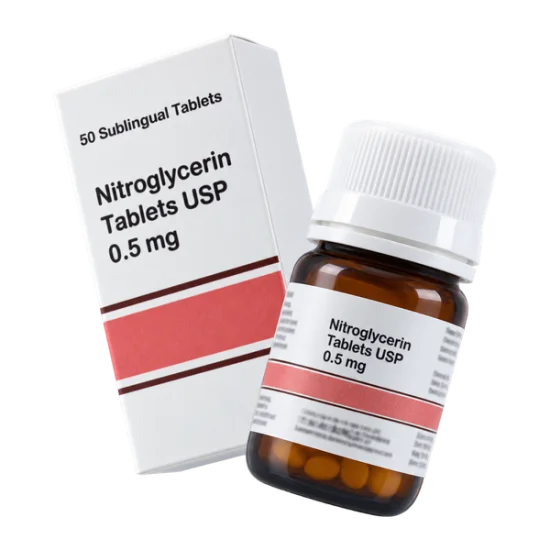
I had been prescribed it for predictable episodes after exercise. The tablet worked within minutes, but the first few uses caused a strong headache and I felt better sitting still. I learned not to take it while walking around.
Nitroglycerin
Nitroglycerin is a nitrate-class antianginal medicine for angina pectoris linked to coronary artery disease. The sublingual tablet is intended for this setting, while dosing differs between strengths and users, so no single amount suits everyone.
Overview
Nitroglycerin belongs to the nitrate class of antianginal drugs. It is used for angina pectoris linked to coronary artery disease, where narrowed or spasming coronary arteries limit oxygen delivery to the heart muscle.
Directions for use
Nitroglycerin sublingual tablets are designed for rapid use when angina begins or when a known trigger is expected. The tablet is placed beneath the tongue while the person remains seated. It should not be chewed or swallowed as an ordinary oral tablet.
Dosing differs between strengths and between users, so there is no single amount that suits everyone. For the sublingual tablet, a commonly used adult regimen is one tablet at the onset of chest pain, followed by another dose after about five minutes if symptoms continue. Emergency services should be contacted promptly if pain persists after the first dose or worsens; some prescribing regimens allow no more than three doses within 15 minutes, but the patient’s individual plan takes priority.
The medicine is not intended to be used repeatedly throughout the day without a clinical plan. Frequent attacks may indicate that coronary disease is not adequately controlled. They require medical reassessment. Keep a record of timing and triggers. Share this information with the prescriber.
| Route | Typical clinical role | Practical feature |
|---|---|---|
| Sublingual tablet | Rapid relief of an acute angina episode | Absorbed beneath the tongue; short duration |
| Translingual spray | Rapid relief when a spray formulation is prescribed | Useful when a tablet is difficult to position |
| Modified-release oral nitrate | Prevention of recurrent symptoms | Longer exposure; not a substitute for acute sublingual treatment |
A dose that is missed during a planned preventive schedule should not be replaced by an extra dose unless the prescriber has given that instruction. For an acute episode, use the prescribed emergency plan rather than taking repeated tablets close together.
Formulation
Nitroglycerin is a nitrate-class antianginal medicine supplied as sublingual tablets for angina pectoris linked to coronary artery disease.
Mechanism of action
Nitroglycerin is converted into nitric oxide within vascular smooth muscle. This activates guanylate cyclase and increases cyclic guanosine monophosphate, causing the muscle in the vessel wall to relax. Venous dilation reduces the amount of blood returning to the heart, known as preload. The heart then works against less pressure and requires less oxygen.
The main cardiovascular effect is venodilation. Arterial dilation can also reduce the resistance against which the left ventricle pumps, while dilation of larger coronary arteries may improve blood flow in some patients.
Nitroglycerin can relieve pain without directly increasing the force of the heartbeat. Its benefit comes from changing the balance between myocardial oxygen supply and demand. Lower venous return reduces ventricular filling pressure, and reduced cardiac workload can ease ischaemic chest discomfort.
The pharmacological profile of short-acting nitrates is described in regulatory prescribing information from the FDA and reflected in clinical guidance for stable angina [1].
Therapeutic indications
It is used for angina pectoris linked to coronary artery disease, where narrowed or spasming coronary arteries limit oxygen delivery to the heart muscle. The medicine can also be used in selected acute cardiac settings under medical supervision, including some cases of acute heart failure or myocardial infarction.
Common mistakes
Several usage errors can delay relief or increase adverse effects:
- Swallowing the tablet instead of leaving it under the tongue.
- Taking repeated doses after severe or changing chest pain without seeking emergency help.
- Standing immediately after administration.
- Using nitroglycerin after sildenafil, tadalafil, vardenafil, or avanafil.
- Combining it with alcohol and then assuming dizziness is unrelated.
- Taking extra tablets to compensate for a missed preventive dose.
- Keeping the medicine in a hot or damp environment, which may affect tablet stability.
- Continuing strenuous activity after the first warning symptoms instead of stopping and sitting down.
- Treating every episode as ordinary angina, even when the pain is new, prolonged, or occurring at rest.
One detail patients often miss is that a headache can appear before the chest pain has fully settled. That symptom may reflect nitrate-related vasodilation, while faintness or collapse indicates a more serious blood-pressure response.
Reasons not to use it
The medicine should not be used in the following situations unless a specialist has given a specific plan:
- Recent use of a phosphodiesterase-5 inhibitor, including sildenafil, tadalafil, vardenafil, or avanafil.
- Use of riociguat, which can produce dangerous additive vasodilation.
- Severe hypotension, circulatory collapse, or shock.
- Severe anaemia or known methaemoglobinaemia.
- Raised intracranial pressure, including some forms of head injury or cerebral bleeding.
- Suspected right-sided myocardial infarction with marked dependence on venous filling.
- A known allergy to nitroglycerin or a tablet ingredient.
The interaction with phosphodiesterase-5 inhibitors is one of the most important safety issues. The combination can cause a profound fall in blood pressure, loss of consciousness, heart attack, or death. Nitrates must also be separated from riociguat and used cautiously with antihypertensives, diuretics, alpha-blockers, beta-blockers, calcium channel blockers, and medicines that contribute to dehydration. EMA guidance on nitrate vasodilators supports careful assessment of blood pressure, cardiovascular status, and interacting medicines [3]. The British National Formulary also addresses nitrate interactions.
When this is not for you
Pregnancy and breastfeeding require an individual risk assessment. Older adults and people with low blood pressure may experience stronger dizziness after a standard dose.
Unwanted effects
Nitroglycerin lowers vascular resistance and venous pressure. Those effects explain both its benefit and its main adverse reactions. Headache, flushing, dizziness, weakness, nausea, palpitations, and a fall in blood pressure can occur. The FDA prescribing information identifies headache and hypotension as clinically relevant effects of sublingual nitroglycerin [2].
A throbbing headache is common during nitrate treatment. It may improve as the body adapts, although persistent or severe headache can make continued use difficult. Dizziness is more likely when the person stands quickly, is dehydrated, has been vomiting, or is taking other medicines that reduce blood pressure.
Possible serious effects include:
- Fainting or near-fainting caused by a marked fall in blood pressure.
- Severe weakness, confusion, or inability to stand.
- Fast or irregular heartbeat associated with significant hypotension.
- Worsening chest pain, breathlessness, sweating, or nausea.
- Rare methaemoglobinaemia, especially after excessive exposure or in susceptible patients.
Chest pain that changes character, lasts longer than usual, occurs at rest, or appears with breathlessness or collapse requires urgent assessment. Relief after nitroglycerin does not prove that the episode was harmless.
Alcohol can intensify vasodilation and increase dizziness, fainting, and low blood pressure. Combining alcohol with nitroglycerin is therefore a poor choice during the period when acute treatment is being used.

Comparison
Nitrates differ in how quickly they act and how long their effect lasts. Nitroglycerin sublingual tablets are used for rapid symptom relief. Isosorbide dinitrate and other longer-acting nitrate preparations may be prescribed for prevention, depending on the pattern of angina and the patient’s wider treatment plan.
Antianginal drugs from other classes work through different pathways. Beta-adrenoceptor antagonists reduce heart rate and contractility. Calcium channel blockers reduce arterial resistance, slow conduction in some cases, or relax vascular smooth muscle. The choice depends on blood pressure, heart rate, left-ventricular function, asthma history, rhythm disorders, and other conditions.
| Treatment category | Main role | Key limitation |
|---|---|---|
| Sublingual nitroglycerin | Rapid relief during acute angina | Short duration; may cause headache and hypotension |
| Longer-acting nitrates | Prevention of recurrent angina | Tolerance can develop without a nitrate-free interval |
| Non-nitrate antianginal drugs | Long-term symptom control | Suitability depends on heart rate, blood pressure, rhythm, and comorbidities |
Isosorbide dinitrate is also used for angina pectoris, but it should not be substituted for sublingual Nitroglycerin without a prescribed plan. A longer-acting preparation may be useful for prevention yet unsuitable for immediate relief.
Lacidipine belongs to the calcium channel blocker category and may be used for hypertension. It is not a replacement for sublingual nitroglycerin during sudden chest pain.
What doctors say
In clinical practice, doctors often describe sublingual Nitroglycerin as a rescue treatment rather than a complete strategy for coronary disease. It can relieve an episode, but repeated reliance on it may signal worsening angina, poor adherence to preventive treatment, anaemia, uncontrolled hypertension, or a new cardiac problem.
A cardiologist will usually ask about the timing, frequency, trigger, duration, and associated symptoms of each episode. Chest pain during exertion that settles with rest and prescribed nitroglycerin follows a different pattern from pain occurring at rest with sweating, breathlessness, faintness, or nausea.
Patients sometimes stop carrying their medicine because attacks become less frequent. That creates a practical risk: the treatment may be most valuable when it is immediately available during an unexpected episode. Another common problem is using a dose while standing, then feeling faint before reaching a safe seat.
What customers often ask
Can a Nitroglycerin tablet be split, crushed, or chewed?
The sublingual tablet should not be crushed or chewed. The intended route is beneath the tongue, where the medicine can dissolve and enter the circulation quickly. FDA prescribing information available in 2023 describes sublingual administration as the route for acute angina relief. A tablet that is swallowed may act more slowly and should not be treated as an ordinary oral dose.
How long does one sublingual dose keep working?
A sublingual dose is intended for short-term relief rather than full-day prevention. The effect begins rapidly, while the duration varies with the episode, circulation, dose, and individual response. The MHRA’s UK medicines information in 2024 supports using short-acting nitrate treatment as part of an acute angina plan, not as a replacement for preventive therapy. Recurrent pain after initial relief needs medical review.
Can alcohol be used while taking Nitroglycerin?
Alcohol can increase the blood-pressure-lowering effect of Nitroglycerin. The result may be dizziness, flushing, fainting, or impaired judgement during an angina episode. A 2023 FDA review of nitrate prescribing information identifies additive vasodilation as a relevant clinical concern. Avoid alcohol when using the medicine for acute symptoms, especially if other blood-pressure medicines are also being taken.
Which symptoms mean that Nitroglycerin should be stopped and urgent medical help sought?
Urgent help is needed for chest pain that is severe, new, prolonged, occurs at rest, or does not improve promptly according to the prescribed plan. Collapse, severe breathlessness, blue-grey lips, confusion, marked weakness, or a very fast or irregular heartbeat also require emergency attention. NICE guidance for stable angina, updated before 2026, treats a change in symptom pattern as a reason for prompt assessment. Do not keep taking repeated doses while delaying emergency care.
Can Nitroglycerin be combined with medicines for erectile dysfunction?
Nitroglycerin must not be combined with phosphodiesterase-5 inhibitors such as sildenafil, tadalafil, vardenafil, or avanafil. The interaction can cause a rapid and dangerous fall in blood pressure. EMA cardiovascular medicine guidance available in 2024 identifies nitrate exposure with phosphodiesterase-5 inhibition as a major contraindicated combination. Emergency clinicians must know when one of these medicines was last taken.
Does Nitroglycerin cause headaches?
Headache is a well-known effect of nitrate-induced blood-vessel dilation. It may be throbbing and can occur soon after a sublingual dose. The FDA’s 2023 prescribing information lists headache among the characteristic reactions associated with nitroglycerin. A mild, familiar headache may accompany treatment, while collapse, severe weakness, or continuing chest pain requires urgent assessment.
Do you offer anonymous delivery?
Your order will be securely packed and shipped within 24 hours. This is exactly what your package will look like (images of an actual item sent). It has the size and look of a regular private letter (24x11x0.7 cm) and its contents cannot be seen.
How Buyers Rate Nitroglycerin
The relief was reassuring when the pain followed my usual pattern. I still had two episodes that felt different, with sweating and breathlessness, so I called for urgent help rather than taking several tablets. The headaches became less troublesome after a while.
I disliked the flushing and pounding headache. The chest discomfort eased, but I was unsure whether the symptoms were a side effect or something more serious. My treatment plan was changed after review because the attacks were happening more often.
I had not needed one for weeks and then realised I had left the medicine in a warm car. I replaced it and now keep it with my regular medicines, away from heat. The practical part was remembering to sit down before using it.
Sources
- U.S. Food and Drug Administration (2023). Nitrostat (nitroglycerin) sublingual tablets prescribing information.
- U.S. Food and Drug Administration (2023). Nitroglycerin sublingual tablets: prescribing information and adverse reactions.
- European Medicines Agency (2022). Summary of Product Characteristics (SmPC) — glyceryl trinitrate.