Skip to content
Spiriva

Spiriva

Quality products
24/7 Support
Fast delivery
Delivery from 4 days
Active ingredient Tiotropium

Free delivery on orders from £ 166.00, free express delivery from £ 249.00

Spiriva Respimat helps relax airway muscles and improve airflow, but it is not a rescue inhaler for sudden breathlessness. Its reusable inhaler delivers a measured spray from a cartridge.

Overview

Tiotropium, the active ingredient in Spiriva, is a long-acting muscarinic antagonist inhaler for ongoing COPD symptom control.

Directions for use

Spiriva Respimat administration

Spiriva Respimat is a soft-mist inhaler, not a capsule inhaler. The capsule-based HandiHaler instructions sometimes associated with Spiriva do not apply to the Respimat presentation described here.

Respimat preparation and inhalation steps

The usual technique is:

  1. Prepare the reusable Respimat according to the device instructions supplied for that inhaler.
  2. Keep the inhaler upright and remove the cap.
  3. Turn the clear base until it clicks.
  4. Open the cap fully.
  5. Breathe out slowly away from the mouthpiece.
  6. Seal your lips around the mouthpiece without covering the air vents.
  7. Begin a slow, deep breath through your mouth while pressing the dose-release button.
  8. Continue breathing in slowly for as long as comfortable.
  9. Hold the breath briefly, then breathe normally.
  10. Close the cap after use.

The prescribed regimen for COPD commonly involves two inhalations once daily, though the amount per intake is set individually and the licensed use depends on the formulation and diagnosis. Follow the specific regimen issued for the Spiriva presentation prescribed to you.

Do not spray the medicine into the eyes. Eye exposure can worsen narrow-angle glaucoma and may cause eye pain or visual halos.

Technique errors and device maintenance

A slow inhalation is important. Breathing in too quickly can reduce how well the soft mist reaches the lower airways. Exhaling through the mouthpiece can also interfere with the next dose.

A simple technique check is to watch the mist: press the dose button during a slow breath in, not before inhaling and not after the breath has finished.

Clean the mouthpiece and device at the interval specified for the Respimat model. Do not immerse the device in water or improvise a cleaning schedule. A dirty mouthpiece can interfere with consistent dosing and may leave residue around the spray outlet.

Spiriva dose use and treatment monitoring

Use Spiriva at the prescribed regular interval. The amount per intake is determined individually rather than being one fixed amount for every patient.

  • Use the inhaler only by oral inhalation.
  • Take the prescribed inhalations once daily unless the prescriber has given a different regimen.
  • Do not take extra doses to compensate for breathlessness.
  • If a dose is missed, take it when remembered unless the next scheduled dose is close.
  • Do not double the next dose.
  • Seek urgent medical advice after suspected excessive use with palpitations, severe blurred vision, eye pain, confusion or difficulty passing urine.

A missed dose occasionally is unlikely to cause an immediate crisis, but repeated missed doses can reduce day-to-day symptom control. A diary showing inhaler use, breathlessness, walking tolerance and reliever use can help identify whether the regimen is working.

Formulation

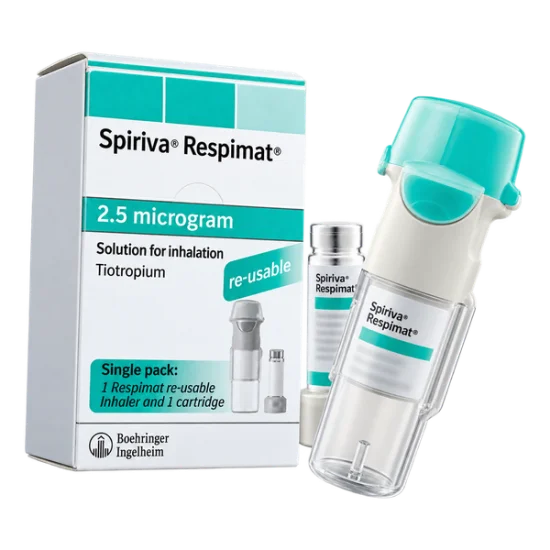
Spiriva Respimat contains tiotropium bromide, a long-acting bronchodilator administered as an inhaled solution. Each actuation delivers 2.5 micrograms of tiotropium. The inhaler contains one reusable Respimat device and one cartridge.

Tiotropium classification and treatment role

A bronchodilator relaxes the smooth muscle surrounding the airways. Tiotropium belongs to the long-acting muscarinic antagonist class, also called an anticholinergic inhaler. It is designed for maintenance treatment rather than immediate relief.

COPD symptoms addressed by Spiriva

Patients may notice easier walking, less morning chest tightness or reduced reliance on a reliever inhaler after regular treatment. The response varies with lung function, smoking status, the severity of COPD, previous exacerbations and other conditions such as heart disease.

A practical limitation is worth keeping in mind: a long-acting inhaler cannot compensate for an incorrect diagnosis, continued smoking exposure or poor inhaler technique. These factors can make a suitable treatment appear ineffective.

Keep the reliever inhaler prescribed for sudden symptoms separate from Spiriva in your daily routine. Spiriva is maintenance treatment, not a replacement for acute-relief therapy.

Mechanism of action

Acetylcholine is a chemical messenger that can tighten airway smooth muscle and increase airway narrowing. Tiotropium blocks muscarinic signalling in the lungs, reducing this constricting effect.

Muscarinic receptor blockade in the airways

Tiotropium acts mainly at M1 and M3 muscarinic receptors. Blocking M3 receptors reduces acetylcholine-driven contraction of airway smooth muscle. This produces bronchodilation, meaning the airway tubes remain more open for air to move through.

The term anticholinergic describes medicines that reduce the effect of acetylcholine. The same pharmacology also explains some unwanted effects, such as dry mouth, constipation, blurred vision after eye exposure and difficulty passing urine.

One useful analogy is a brake-release mechanism: acetylcholine applies pressure towards airway narrowing, while tiotropium reduces that signal. The analogy ends there; the clinical action depends on receptor blockade and the patient’s underlying lung disease.

Therapeutic indications

Tiotropium is prescribed mainly for chronic obstructive pulmonary disease (COPD), including chronic bronchitis and emphysema. It can reduce daily breathlessness, chest tightness, wheezing and activity limitation by keeping the airways more open. It does not cure COPD or reverse established lung damage, yet regular use can support steadier breathing and reduce the likelihood of worsening symptoms in suitable patients [1].

Review triggers in COPD

Worsening breathlessness, reduced exercise tolerance, more frequent night symptoms or repeated need for a reliever inhaler should prompt a treatment review. Frequent chest infections or exacerbations also need assessment because the treatment plan may require adjustment.

Common mistakes

Several avoidable errors appear repeatedly in inhaler reviews:

  • Treating Spiriva as a rescue inhaler during sudden breathlessness.
  • Taking extra sprays instead of using the prescribed reliever.
  • Pressing the dose button before beginning a slow inhalation.
  • Spraying into the eyes.
  • Stopping treatment after a few comfortable days.
  • Continuing a second anticholinergic inhaler without a medication review.
  • Ignoring urinary difficulty or new eye pain.
  • Failing to clean the mouthpiece as directed for the device.
  • Assuming a cough always means the inhaler is unsuitable.
  • Continuing to smoke while expecting inhaler treatment alone to prevent progression.

A rescue inhaler may still be prescribed alongside Spiriva. The two medicines serve different purposes.

Reasons not to use it

The following situations require specific clinical assessment before use:

  • Previous serious allergy to tiotropium, atropine-like medicines or another component of the inhaler.
  • Narrow-angle glaucoma or a history of acute angle closure.
  • Urinary retention, bladder-outflow obstruction or significant prostate enlargement.
  • Severe kidney impairment, where systemic exposure may be increased.
  • Previous paradoxical bronchospasm after an inhaled medicine.
  • Pregnancy or breastfeeding, when the expected benefit and potential risk need individual assessment.

Anticholinergic medicines can add to the effects of other anticholinergic drugs used for bladder symptoms, gastrointestinal spasm, motion sickness, some neurological conditions and certain allergy treatments. Combining inhalers with overlapping anticholinergic action can increase dry mouth, constipation, blurred vision, urinary retention and palpitations.

When this is not for you

Spiriva is not suitable for everyone. NOT for you if you have a serious allergy to tiotropium or related anticholinergic medicines, or if a clinician has identified a relevant glaucoma, urinary-retention or bronchospasm risk.

A capsule that looks empty is not relevant to Respimat, because this presentation uses a cartridge and soft-mist spray. Confusing device types can lead to incorrect use.

Unwanted effects

Dry mouth is the most recognisable anticholinergic effect associated with tiotropium. Other possible effects include throat irritation, cough, constipation, headache, blurred vision and urinary difficulty. The MHRA product information distinguishes common reactions from less frequent reactions and serious events [2].

Common anticholinergic effects

Dry mouth may be mild and temporary. Persistent dryness can increase discomfort, affect swallowing and contribute to dental problems. Sugar-free gum or regular mouth care may help, but people on fluid restriction should not increase fluid intake without considering their cardiac or kidney condition.

Constipation may become more troublesome in people already taking medicines that slow bowel movement. Urinary hesitancy deserves attention, especially in men with prostate enlargement.

Throat irritation does not necessarily mean the inhaler has caused an allergy. Facial swelling, widespread rash, wheezing immediately after inhalation or sudden worsening of breathing requires urgent assessment because these symptoms may indicate a serious hypersensitivity or paradoxical bronchospasm reaction.

Urgent reactions and contraindication signals

Seek urgent help for:

  • Severe breathing difficulty immediately after inhalation.
  • Facial, tongue or throat swelling.
  • Acute eye pain, red eye, blurred vision or coloured halos.
  • Marked palpitations or fainting.
  • Inability to pass urine.
  • Severe confusion or rapidly worsening symptoms.

Comparison

Spiriva and related inhaler comparisons

Different inhalers have different onset, duration and treatment roles. They should not be switched or combined without prescribing guidance.

Treatment Main role and limitation
Spiriva — tiotropium Long-acting muscarinic antagonist for maintenance COPD control; not a rescue inhaler
Atrovent — ipratropium Short-acting muscarinic antagonist; shorter duration and not a substitute for Spiriva without guidance
Salbutamol — also called albuterol Short-acting beta-2 agonist for rapid relief; frequent use suggests inadequate control
Salmeterol with fluticasone Long-acting beta-2 agonist plus inhaled corticosteroid; treatment choice depends on symptoms, exacerbations and steroid-related risks

Atrovent contains ipratropium, while Spiriva contains tiotropium. Both reduce muscarinic airway constriction, but tiotropium is formulated for longer-lasting maintenance control.

Salbutamol, called albuterol in some countries, relaxes airway muscle through beta-2 receptor stimulation and is commonly prescribed as a reliever. It does not provide the same maintenance profile as tiotropium.

Salmeterol is a long-acting beta-2 agonist. Fluticasone is an inhaled corticosteroid that reduces airway inflammation. Corticosteroid-containing combinations may increase pneumonia risk in some people with COPD, while Spiriva contains no inhaled corticosteroid. The best choice depends on exacerbation history, eosinophil count, asthma features, lung function and treatment response. A clinician should reassess the regimen when symptoms or exacerbations change.

What doctors say

Doctor perspectives

In respiratory practice, a common observation is that poor inhaler technique can look like treatment failure. A patient may be using every prescribed dose while receiving very little medicine in the lungs because the inhalation is too fast, mistimed or directed incorrectly.

Another practical point concerns expectations. Spiriva can improve airflow and daily breathing control, yet it does not remove the underlying COPD process. A persistent cough, declining walking distance or increasing rescue-inhaler use deserves review rather than automatic dose escalation.

The FDA also recognises tiotropium as a long-acting bronchodilator for chronic airway disease, while UK treatment decisions follow UK prescribing information and clinical assessment [3].

What customers often ask

Can Spiriva be taken with food or on an empty stomach?

Spiriva Respimat is inhaled, so food does not determine its absorption in the way it can with an oral tablet. It can be used at the prescribed time without coordinating the dose with meals. The 2024 EMA product information for tiotropium supports inhaled administration as a regular maintenance treatment [4].

Can Spiriva be combined with other inhalers or supplements?

Spiriva can be prescribed alongside a short-acting reliever such as salbutamol, also called albuterol, when separate maintenance and rescue treatment is needed. Extra anticholinergic inhalers, including ipratropium products such as Atrovent, can increase dry mouth, blurred vision, constipation and urinary retention. The MHRA safety information from 2024 supports reviewing overlapping anticholinergic treatment before combination use; supplements do not replace this medication review.

What happens when Spiriva is stopped, and does it need tapering?

Tiotropium is not usually tapered in the same way as corticosteroids. Stopping it can allow COPD symptoms to return or worsen because the maintenance bronchodilator effect is removed. GOLD guidance published for COPD management in 2025 supports reviewing the reason for stopping and arranging an alternative plan rather than abandoning maintenance treatment without assessment [5].

Does Spiriva cause dry mouth?

Dry mouth is a recognised anticholinergic adverse effect of tiotropium. It may be mild, yet persistent dryness can affect teeth, swallowing and comfort. The MHRA product information from 2024 advises attention to anticholinergic effects, especially when other medicines with similar activity are used.

How should Spiriva be stored at home and while travelling?

Keep the Respimat device with its cap closed and protect it from excessive heat, freezing conditions and prolonged direct sunlight. Store it securely so the inhaler is not crushed or contaminated in a bag. The WHO good storage practice principles published in 2020 support protecting medicines from damaging temperature, moisture and handling conditions.

Can Spiriva be used during a sudden COPD attack?

Spiriva is not intended to provide rapid relief during an acute attack. Use the prescribed reliever plan for sudden symptoms, and seek urgent help if breathing remains severe, speech becomes difficult or the reliever does not provide the expected relief. The 2024 EMA product information distinguishes Spiriva's maintenance role from treatment for acute symptoms. Spiriva should continue only according to the prescribed maintenance schedule.

What should happen if Spiriva does not improve breathing?

Persistent symptoms may reflect incorrect technique, missed doses, ongoing smoking exposure, infection, another lung condition or a need for treatment adjustment. A clinician should review inhaler technique, symptom pattern, lung function and reliever use. GOLD guidance from 2025 supports clinical reassessment when COPD symptoms remain uncontrolled. Do not respond by taking additional sprays beyond the prescribed regimen.

Do you offer anonymous delivery?

Your order will be securely packed and shipped within 24 hours. This is exactly what your package will look like (images of an actual item sent). It has the size and look of a regular private letter (24x11x0.7 cm) and its contents cannot be seen.

How Buyers Rate Spiriva

4.3
Based on 5 reviews
Liam, 35
Bath
Several months
Verified
Rating: 5 out of 5

I noticed that walking uphill became easier after I had used it regularly for a while. The first few days brought a dry mouth, which settled when I paid more attention to mouth care.

6 Oct 2026
Alan, 60
Belfast
Several months
Verified
Rating: 4.5 out of 5

My breathing was steadier during the day, but I initially pressed the button too early and barely inhaled the mist. A respiratory nurse corrected my technique, and the difference was clear.

15 Oct 2026
Jonathan, 51
Bristol
Several months
Verified
Rating: 4 out of 5

I still needed the reliever during a chest infection, so I had expected Spiriva to prevent every flare-up. It helped my usual symptoms, but it did not replace the emergency plan.

21 Oct 2026
James, 27
Reading
Several months
Verified
Rating: 4 out of 5

The inhaler was easy to carry, although I found the cleaning routine easy to forget. My throat felt irritated at first, and I reported it rather than stopping without advice.

26 Oct 2026
Peter, 48
Dundee
Several months
Verified
Rating: 4 out of 5

I felt more comfortable during normal activity after improving my inhalation technique. I also experienced constipation, which became a reason to review my other medicines rather than simply taking more Spiriva.

1 Nov 2026

Sources

  1. European Medicines Agency (2024). Spiriva Respimat: Summary of Product Characteristics and Product Information.
  2. Medicines and Healthcare products Regulatory Agency (2024). Tiotropium-containing inhalers: product information and safety information.
  3. U.S. Food and Drug Administration (2023). Spiriva Respimat: Prescribing Information.
  4. European Medicines Agency (2024). Tiotropium bromide inhalation solution: European public assessment and product information.
  5. Global Initiative for Chronic Obstructive Lung Disease (2025). Global Strategy for the Prevention, Diagnosis and Management of Chronic Obstructive Pulmonary Disease.
Get our free app Shop faster and track your orders 3.9 · 425 reviews Install