Skip to content
Trusopt

Trusopt

Quality products
24/7 Support
Fast delivery
Delivery from 4 days
Active ingredient Dorzolamide

Free delivery on orders from £ 166.00, free express delivery from £ 249.00

Trusopt is applied as eye drops directly into the affected eye or eyes to reduce raised intraocular pressure. It is intended for people with ocular hypertension or open-angle glaucoma. By lowering pressure, it helps protect the optic nerve from further damage.

Overview

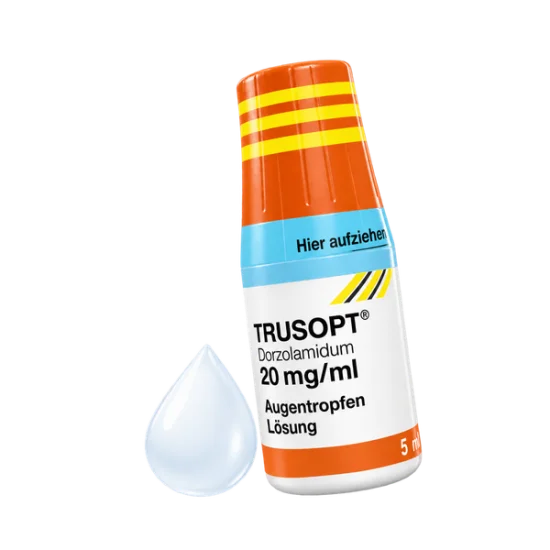
Trusopt is an ophthalmic anti-glaucoma agent supplied as an eye drop solution in a bottle. Its active ingredient is dorzolamide. The amount used at each application is determined individually rather than being one fixed amount.

Raised pressure inside the eye can gradually damage the optic nerve. This damage is often painless at first, which is why glaucoma treatment focuses on maintaining consistently lower intraocular pressure rather than waiting for symptoms to change.

Active Ingredient and Concentration

Dorzolamide is a topical carbonic anhydrase inhibitor. It acts locally after instillation into the eye and is used in adults with ocular hypertension or open-angle glaucoma when pressure reduction is needed.

Trusopt may be used alone when an ophthalmic beta-blocker is unsuitable, or alongside other pressure-lowering eye drops when one treatment does not achieve the target pressure.

Eye drops work best when taken at evenly spaced times each day. Linking doses to regular routines, such as brushing teeth, can reduce missed applications.

Directions for use

The dose is individual. For dorzolamide 2% used on its own, the usual adult regimen is one drop in the affected eye or eyes three times daily. When Trusopt is used with a topical ophthalmic beta-blocker, the usual regimen is one drop twice daily, with morning and evening applications.

Use Trusopt by topical ophthalmic administration only.

  • Wash and dry hands before use.
  • Tilt the head back and look upward.
  • Pull the lower eyelid down to create a small pocket.
  • Instil one drop without allowing the bottle tip to touch the eye, eyelid, fingers, or any surface.
  • Close the eye gently and use punctal occlusion for about two minutes.
  • If more than one eye medicine is prescribed, leave at least 10 minutes between products.
  • Use eye ointments after drops, since ointment can reduce penetration of a drop applied afterwards.

Adult and Paediatric Dosing Regimens

Adults commonly use Trusopt as monotherapy or as add-on treatment. In children, dorzolamide may be prescribed by an ophthalmology specialist, with dosing determined by age, clinical need, and the rest of the glaucoma regimen.

A common error is adding an extra drop because the first drop was not felt. The eye can retain only a limited volume, so the excess usually runs out rather than improving pressure control.

If a drop lands on the cheek, it has not treated the eye. Dry the skin and apply one replacement drop, avoiding contact between the bottle tip and skin.

Formulation

Trusopt is an ophthalmic anti-glaucoma agent supplied as an eye drop solution in a bottle. Its active ingredient is dorzolamide. The amount used at each application is determined individually rather than being one fixed amount.

Raised pressure inside the eye can gradually damage the optic nerve. This damage is often painless at first, which is why glaucoma treatment focuses on maintaining consistently lower intraocular pressure rather than waiting for symptoms to change.

Active Ingredient and Concentration

Dorzolamide is a topical carbonic anhydrase inhibitor. It acts locally after instillation into the eye and is used in adults with ocular hypertension or open-angle glaucoma when pressure reduction is needed.

Trusopt may be used alone when an ophthalmic beta-blocker is unsuitable, or alongside other pressure-lowering eye drops when one treatment does not achieve the target pressure.

Eye drops work best when taken at evenly spaced times each day. Linking doses to regular routines, such as brushing teeth, can reduce missed applications.

Mechanism of action

The eye continuously produces a clear fluid called aqueous humour. This fluid nourishes internal eye structures and normally drains away through specialised channels. When production exceeds drainage, pressure rises.

Dorzolamide blocks carbonic anhydrase in the ciliary processes, the tissues responsible for aqueous humour production. Less fluid is produced, so intraocular pressure falls. This does not restore lost vision, yet pressure control can slow further glaucoma-related optic nerve injury. Regular follow-up is needed to confirm that pressure remains controlled. The European Medicines Agency describes topical dorzolamide as a carbonic anhydrase inhibitor for reducing elevated intraocular pressure in open-angle glaucoma and ocular hypertension [1].

After placing a drop, close the eye gently and press one finger against the inner corner beside the nose for about two minutes. This limits drainage into the nose and throat and may reduce the bitter taste some people notice.

Therapeutic indications

Trusopt is applied as eye drops directly into the affected eye or eyes to reduce raised intraocular pressure. It contains dorzolamide 20 mg/ml and is used for ocular hypertension and open-angle glaucoma, where lowering pressure helps protect the optic nerve from further damage.

Common mistakes

  • Applying drops directly onto a contact lens.
  • Touching the bottle tip to the eye or eyelashes, which can contaminate the solution.
  • Using several eye medicines without a gap between them.
  • Blinking hard immediately after application, which pushes liquid out of the eye.
  • Stopping treatment because vision feels stable.
  • Assuming a bitter taste means an allergy rather than drainage through the tear duct.
  • Doubling the next dose after a missed application.

The most useful habit is simple: one drop, correct timing, and gentle pressure at the inner corner of the eye.

Reasons not to use it

Trusopt is not for you if you have a known hypersensitivity to dorzolamide, sulfonamides, benzalkonium chloride, or another component of the formulation. It is also not appropriate for severe renal impairment, defined as creatinine clearance below 30 ml/min, because dorzolamide and its metabolite are cleared mainly through the kidneys.

Extra clinical caution is needed in the following circumstances:

  • A history of renal calculi, because carbonic anhydrase inhibition can affect urinary chemistry.
  • Chronic corneal defects, low corneal cell count, or previous intraocular surgery.
  • Acute angle-closure glaucoma, which requires urgent ophthalmic management rather than reliance on pressure-lowering drops alone.
  • Severe liver impairment, since Trusopt has not been extensively studied in this group.
  • Current use of oral carbonic anhydrase inhibitors, such as acetazolamide, because systemic effects may be additive.
  • Use of high-dose salicylates, where acid-base disturbances are a concern with carbonic anhydrase inhibition.

When this is not for you

Stop using the drops and seek urgent clinical advice if a severe rash, mouth ulcers, peeling skin, swelling, or breathing symptoms develop.

Unwanted effects

Most adverse effects are local and settle after application. Burning, stinging, eye discomfort, blurred vision, tearing, eyelid inflammation, conjunctivitis, and a bitter taste are among the recognised effects of dorzolamide eye drops. Dizziness can occur, though it is less common.

A bitter taste often appears because liquid has travelled through the tear duct into the throat. Punctal occlusion usually reduces this problem.

Possible reactions include:

  • Common local effects: burning, stinging, itching, redness, watery eyes, eye irritation, eyelid crusting, and altered taste.
  • Visual effects: temporary blurred vision soon after a drop, superficial punctate keratitis, and rarely transient myopia or ocular hypotony.
  • Systemic effects: headache, dizziness, nausea, tiredness, skin reactions, and uncommon kidney stone formation.
  • Urgent reactions: facial swelling, breathing difficulty, widespread rash, severe eye pain, marked vision deterioration, or signs of a serious allergic reaction.

The US Food and Drug Administration product information records bitter taste and ocular burning or stinging among the frequently reported reactions, while serious hypersensitivity reactions are uncommon but clinically significant [2].

Blurred vision immediately after a drop is usually brief. Wait until sight is clear before reading, driving, using stairs, or operating machinery.

Comparison

Trusopt is commonly paired with an ophthalmic beta-blocker when one medicine alone does not lower pressure sufficiently. Beta-blocker eye drops reduce aqueous humour formation through a different pathway, so their effect can be additive.

Treatment approach Main pressure-lowering action Key consideration
Dorzolamide Carbonic anhydrase inhibition Useful when beta-blockers are unsuitable
Ophthalmic beta-blocker Reduces aqueous humour production through beta-receptor blockade May be unsuitable in asthma, bradycardia, or heart block
Combined treatment Additive reduction in aqueous humour production Requires review of eye and systemic tolerability

Timolol ophthalmic solution and betaxolol ophthalmic solution are examples of beta-blocker eye drops that may be used in an ophthalmology plan. Timolol has greater potential for respiratory and cardiac beta-blockade, while betaxolol is relatively beta-1 selective but still requires caution.

What doctors say

In clinical practice, ophthalmologists focus less on whether the eye feels different and more on whether pressure reaches the target range without damaging the cornea or causing intolerable adverse effects. Glaucoma often progresses silently, so symptom improvement is not a reliable measure of success.

Dorzolamide is valued when a patient cannot use an ophthalmic beta-blocker because of asthma, slow heart rate, or certain heart-conduction disorders. Its limitation is the need for repeated daily use when prescribed alone, plus the possibility of stinging and bitter taste.

NICE glaucoma guidance supports treatment plans based on intraocular pressure, optic nerve status, visual-field findings, and an individual patient’s risk of progression [3].

What customers often ask

What should happen if Trusopt does not produce the expected result?

Raised eye pressure cannot be judged by how the eye feels. An ophthalmology review is needed to measure intraocular pressure and assess the optic nerve, visual field, adherence, and application technique. Treatment may involve adjusting the regimen, adding another pressure-lowering class, or considering laser or surgical options when drops do not reach the target pressure. NICE guidance published in 2022 supports escalation according to measured pressure control and risk of visual loss .

Can Trusopt affect driving, concentration, or work with machinery?

Trusopt can cause temporary blurred vision, dizziness, or eye irritation after application. Avoid driving or using machinery until vision is clear and you feel fully alert. This is most relevant just after instillation and may be more noticeable when starting treatment or adding another eye medicine. The FDA prescribing information updated in 2024 includes blurred vision and dizziness among reported adverse effects .

How long does one Trusopt application keep working?

Dorzolamide begins reducing aqueous humour production after topical application, but its clinical use depends on regular dosing rather than a single isolated effect. The prescribed frequency maintains pressure reduction across the day and night. Monotherapy is commonly dosed three times daily, while use alongside a topical beta-blocker is commonly twice daily. EMA product information from 2024 sets out these regimen differences for dorzolamide 2% eye drops .

Can Trusopt be used during pregnancy or breastfeeding?

Pregnancy and breastfeeding require individual assessment because dorzolamide may be absorbed systemically even though it is applied to the eye. Human pregnancy data remain limited, and decisions should balance glaucoma control against potential fetal or infant exposure. Punctal occlusion after each drop is useful because it reduces drainage into the nose and systemic absorption. EMA product information published in 2024 advises careful benefit-risk assessment for pregnancy and lactation .

What should happen after a missed Trusopt application?

Apply the missed dose when remembered unless the next scheduled application is near. If it is nearly time for the next dose, continue with the usual schedule and do not use a double dose. Repeated missed applications can allow pressure to rise without producing obvious symptoms. The MHRA's 2023 guidance advises that consistent use of prescribed glaucoma treatment is central to reducing the risk of progressive vision loss [4].

Do you offer anonymous delivery?

Your order will be securely packed and shipped within 24 hours. This is exactly what your package will look like (images of an actual item sent). It has the size and look of a regular private letter (24x11x0.7 cm) and its contents cannot be seen.

How Buyers Rate Trusopt

4.3
Based on 4 reviews
Louise, 29
Reading
Four months
Verified
Rating: 5 out of 5

Reading, used one drop of Trusopt in one eye alongside another glaucoma drop for four months: “The first week brought a sharp sting and a bitter taste, which I found unpleasant. Pressing the corner of my eye afterwards made a real difference, and my pressure readings improved at follow-up.”

6 Oct 2026
Ellie T., 52
Derby
Three months
Verified
Rating: 3.5 out of 5

The drops twice daily for three months: “I had dry, irritated eyes at the start and needed to remove my soft lenses first. The routine became manageable once I kept the bottle near my toothbrush and left enough time before putting lenses back in.”

18 Oct 2026
Amanda, 57
Middlesbrough
Six weeks
Verified
Rating: 4 out of 5

used one drop of Trusopt for six weeks: “My pressure lowered, but I still had blurry vision for a few minutes after each dose. It was inconvenient before work, so I started taking the morning drop earlier rather than rushing straight out.”

25 Oct 2026
Jane R., 44
Dundee
Five months
Verified
Rating: 4.5 out of 5

used one drop of Trusopt with a beta-blocker eye drop for five months: “The combination reduced my pressure more than the first treatment alone. I accidentally used both drops one after the other once and felt most of it run down my face, so I now set a timer for the gap.”

1 Nov 2026

Sources

  1. European Medicines Agency (2024). Trusopt: Summary of Product Characteristics.
  2. U.S. Food and Drug Administration (2024). TRUSOPT (dorzolamide hydrochloride ophthalmic solution) prescribing information.
  3. National Institute for Health and Care Excellence (2022). Glaucoma: diagnosis and management (NG81).
  4. Medicines and Healthcare products Regulatory Agency (2023). Glaucoma: patient information and treatment safety guidance.
Get our free app Shop faster and track your orders 3.9 · 425 reviews Install