The first change was that I could leave shaving for longer between sessions. I still needed to remove the existing hair, and the improvement was gradual rather than dramatic.
Vaniqa
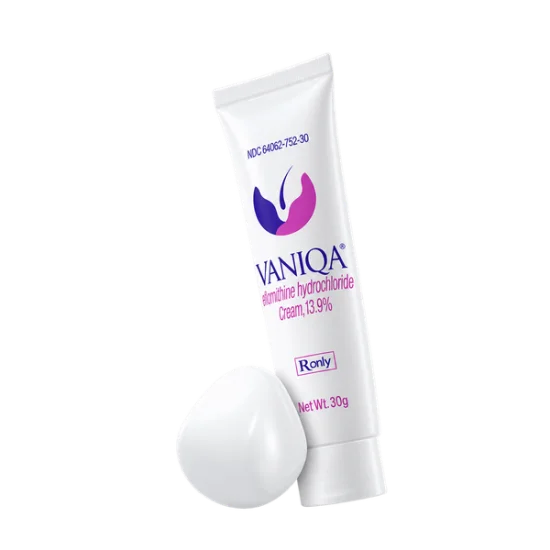
Eflornithine hydrochloride, the active ingredient in Vaniqa, is a topical enzyme inhibitor for adult women with unwanted facial hair. It is prescribed for reducing unwanted facial hair in adult women, including hair associated with hirsutism.
Overview
Vaniqa slows new hair growth from the follicle, helping facial-hair management alongside shaving, waxing, threading, or other removal methods.
Directions for use
Apply Vaniqa as a thin layer twice daily, with applications separated by at least eight hours. Continue the routine consistently unless the prescriber gives different instructions.
- Clean and dry the facial area first.
- Apply a thin layer to the affected facial or neck skin.
- Avoid the eyes, mouth, nostrils, cuts, and inflamed skin.
- Wash hands after application.
- Leave the cream on the skin for at least four hours before washing the treated area.
- Continue the usual hair-removal method when needed.
- Keep applications separated by approximately eight hours.
- Do not apply extra cream after a missed dose.
The correct amount differs between strengths and between users, so there is no single amount that suits everyone. A thin layer covering the affected area is the practical rule; covering the skin with a thick coating does not improve the biological action.
| Application point | Practical instruction | Reason |
|---|---|---|
| Frequency | Twice daily, about eight hours apart | Maintains regular exposure at the follicle |
| Amount | Thin layer over the treated area | Avoids unnecessary skin irritation |
| Washing | Wait at least four hours | Reduces premature removal of the cream |
If an application is missed, apply the next scheduled dose when convenient. Do not double the amount to compensate.
The cream should not be applied immediately before activities that will wash or rub it away. Sweat, cleansing, and facial products can shorten contact time if used too soon after treatment.
Formulation
Vaniqa contains eflornithine hydrochloride at a concentration of 13.9% in a topical cream.
Mechanism of action
Eflornithine inhibits ornithine decarboxylase, an enzyme involved in polyamine production. Polyamines support cellular activity within the follicle, including processes linked with hair-shaft formation. By reducing this enzyme activity, eflornithine can slow the rate of new facial-hair growth. The FDA prescribing information describes this action as a reduction in hair-growth rate rather than permanent hair removal [1].
Targeting Enzymes Within Hair Follicles
The active ingredient works locally where it is applied. It does not bleach the hair or dissolve the existing hair shaft, so previously grown hair remains until removed by the person’s usual method.
Therapeutic indications
Vaniqa Cream is used to reduce or slow unwanted and excessive hair growth on the face. It is most useful when facial hair returns quickly after ordinary removal and when reducing regrowth would make daily grooming easier.
Clinical trials found that improvement usually develops gradually with twice-daily application. The cream can reduce the speed and density of new growth, although it does not remove established hair and does not permanently destroy every treated follicle [2].
Potential practical benefits include:
- Longer intervals between shaving, threading, waxing, or other hair-removal sessions.
- Less visible regrowth between removal sessions.
- A lower daily grooming burden for some women.
- A treatment option that acts locally on facial hair rather than affecting hair throughout the body.
Local irritation, dryness, or stinging can limit continued use for some people.
- Use alongside an established hair-removal routine.
Target Treatment Areas on the Face and Neck
Apply the cream only to the facial or adjacent neck areas prescribed for treatment. Avoid the eyes, lips, nostrils, broken skin, and mucous membranes. More cream does not produce faster results and may increase irritation.
Use a clean fingertip to spread a thin film over the skin rather than rubbing a thick layer into one small patch. Wash the hands after application unless the hands are the treated area.
Vaniqa is not a replacement for immediate hair removal. Existing hair may still need to be shaved or removed while the treatment takes effect.
Common mistakes
Several routine errors can reduce benefit or increase irritation:
- Applying the cream only when hair is visible instead of using it regularly.
- Using a thick layer in the belief that more product works faster.
- Washing the area soon after application.
- Applying it over cuts caused by shaving.
- Using it immediately after waxing or threading when the skin is inflamed.
- Applying it to the eyelids, lips, nostrils, or other sensitive surfaces.
- Doubling the amount after a missed application.
- Stopping after two or three weeks because the hair has not changed.
- Changing the hair-removal method repeatedly, making progress difficult to judge.
- Continuing despite severe swelling, blistering, or a spreading rash.
A further mistake is expecting Vaniqa to reverse the cause of hirsutism. It acts on facial-hair growth and does not correct PCOS, androgen excess, thyroid disease, or other endocrine conditions.
Reasons not to use it
- Previous allergy to eflornithine hydrochloride or any cream component.
- Broken, infected, severely inflamed, or eczema-affected skin at the application site.
- Pregnancy, planned pregnancy, or breastfeeding.
- Significant liver or kidney disease.
- Other topical medicines being applied to the same facial area.
- A history of severe reactions to topical creams.
Vaniqa should not be used on damaged skin until the area has healed. Application over cuts can increase burning and may increase absorption through compromised skin.
There are no well-established systemic drug interactions comparable with those seen after oral medicines because eflornithine is applied to the skin. Combining several irritating topical products can still worsen local reactions.
When this is not for you
Vaniqa may not be for you if you are pregnant, breastfeeding, allergic to eflornithine, or have damaged skin at the treatment site.
Pregnancy requires a specific treatment decision because the safety evidence is limited. Breastfeeding also needs individual assessment, especially if the cream could contact the breast or if the treated area may come into contact with an infant.
Unwanted effects
Most unwanted effects are local skin reactions. Reported reactions include burning, stinging, redness, dryness, itching, acne-like spots, inflamed hair follicles, and irritation around the treated area. These effects may be more noticeable during the first weeks or when the cream is applied after aggressive hair removal.
The FDA product information lists acne, inflamed hair follicles, stinging, burning, redness, itching, rash, and dryness among reported reactions . Some reactions may be related to the cream base or to shaving, waxing, threading, or other methods used at the same time.
Practical measures include:
- Use a thin layer rather than a heavy application.
- Avoid applying it to freshly scratched or broken skin.
- Pause harsh exfoliating products if irritation develops.
- Avoid getting the cream into the eyes or mouth.
- Contact the prescriber if irritation is persistent, severe, blistering, or spreading.
Stop use and obtain prompt medical advice for facial swelling, widespread hives, breathing difficulty, or a severe skin reaction. These symptoms can indicate a significant allergic response.
One detail patients often miss: burning after application can be caused by applying the cream straight after waxing or threading, not only by intolerance to eflornithine. Allowing irritated skin to recover can make the routine more comfortable.
Another practical point concerns cosmetics. Heavy fragranced products, exfoliating acids, retinoids, and alcohol-based toners may increase stinging when used on the same area. Introduce such products cautiously and avoid putting them directly over freshly treated skin.

Comparison
Vaniqa changes the rate of hair production at the follicle. Other methods mainly cut, dissolve, pull out, or damage existing hair.
| Approach | Main action and typical limitation |
|---|---|
| Vaniqa cream | Slows new facial-hair growth; results develop gradually and existing hair still needs removal |
| Depilatory cream | Chemically dissolves hair at the skin surface; regrowth returns and irritation is possible |
| Shaving or mechanical removal | Removes visible hair without changing follicle activity; repeated treatment is needed |
Depilatory creams can act quickly, but they may sting and are not automatically suitable for facial skin. A product designed for the legs or body should not be assumed to be appropriate for the face.
Shaving cuts the hair at the skin surface and does not make the follicle produce thicker hair. Threading and waxing remove hair from the root, yet they can cause redness, folliculitis, or ingrown hairs. Laser-based treatment and electrolysis use different clinical approaches and require assessment of hair colour, skin type, treatment area, and expected course.
Vaniqa is often used as an adjunct rather than a standalone removal method. Its role is to reduce the rate of regrowth while the person continues the method that controls existing hair.
What doctors say
In clinical practice, a prescriber will usually set expectations before treatment begins: Vaniqa works gradually, needs regular application, and does not provide permanent hair removal. The best response is easier to judge when the same hair-removal routine is maintained rather than changing several methods at once.
A clinician will also consider the pattern of hair growth. Facial hair associated with PCOS or another androgen-related condition may need assessment beyond topical treatment. Treatment of the underlying hormonal condition may be discussed separately from facial-hair management.
The Medicines and Healthcare products Regulatory Agency, or MHRA, and the European Medicines Agency place emphasis on appropriate patient selection, local tolerability, and correct topical use for medicines in this category [3]. A prescription review may include the affected areas, menstrual history, acne, medication use, pregnancy possibility, and skin sensitivity.
One useful clinical observation is that patients may judge the cream too early. Photographs taken at consistent intervals can make gradual changes easier to assess than day-to-day mirror checks, provided the same lighting and hair-removal routine are used.
What customers often ask
What should I do if the expected result does not come?
Allow several weeks of regular use before judging the response; clinical evidence reviewed by the FDA found that improvement may become clearer from around eight weeks . Check that applications are twice daily, separated appropriately, and left on the skin for at least four hours. If there is no worthwhile improvement after six months, contact the prescribing clinician for reassessment of the diagnosis and treatment plan.
What happens when Vaniqa is stopped, and does treatment need tapering?
Vaniqa does not normally require tapering because it is a topical treatment that is stopped rather than gradually reduced. The follicle can resume its previous growth pattern, so facial hair may gradually return after treatment ends. Patient information associated with the European Medicines Agency describes regrowth as possible after discontinuation, with the previous pattern potentially returning within several weeks .
Can I drive, concentrate, or work with machinery while using Vaniqa?
Vaniqa is applied to the skin, and it is not expected to impair driving, concentration, or ordinary work with machinery. The 2024 NHS and MHRA safety guidance addresses topical medicines according to their known systemic effects and individual adverse reactions, so severe dizziness, visual symptoms, or an allergic reaction would require stopping the activity and obtaining medical advice. Avoid driving if another medicine or a medical condition is affecting alertness.
How much Vaniqa should I apply, where should I apply it, and should I wash my hands?
Apply a thin layer to the prescribed facial or adjacent neck areas, avoiding the eyes, lips, nostrils, broken skin, and mucous membranes. Wash your hands after application unless your hands are the treatment area, and do not cover the cream with an occlusive dressing. The 2000 FDA label specifies twice-daily use and a minimum four-hour period before washing the treated area.
What should I check or discuss with a doctor before starting?
Discuss pregnancy, breastfeeding, allergies, kidney or liver disease, damaged facial skin, and every cream or acne treatment used on the same area. A clinician may also assess sudden or rapidly progressing facial hair, irregular periods, acne, voice changes, or other signs of androgen excess. The 2019 World Health Organization guidance on women’s health supports evaluating underlying causes when symptoms suggest a broader endocrine problem rather than treating the visible symptom alone [4].
How long does one application keep working?
A single application is intended to remain on the skin for at least four hours, but the clinical benefit comes from repeated twice-daily use rather than one isolated application. Washing it off early may reduce contact with the follicle, while applying extra cream does not extend the effect. The 2000 FDA clinical studies supporting eflornithine treatment assessed regular use over weeks, not a one-off application.
Do you offer anonymous delivery?
Your order will be securely packed and shipped within 24 hours. This is exactly what your package will look like (images of an actual item sent). It has the size and look of a regular private letter (24x11x0.7 cm) and its contents cannot be seen.
How Buyers Rate Vaniqa
I noticed less obvious regrowth around my chin. The cream stung when I used it straight after threading, so I started waiting until the skin had settled.
My skin became dry and slightly red during the first fortnight. Moisturiser helped when used separately, but I stopped for several days when the irritation became uncomfortable and then discussed restarting with my prescriber.
The main benefit was needing to shave less often. I expected the hair to disappear, which was unrealistic, but the slower regrowth made daily grooming easier.
The result was modest for me, and the cream was awkward to fit around my morning routine. After stopping, the facial hair gradually returned, so I did not view it as a permanent solution.
Sources
- U.S. Food and Drug Administration (2000). VANIQA (eflornithine hydrochloride) cream, 13.9%: Prescribing Information.
- U.S. Food and Drug Administration (2000). VANIQA clinical studies and prescribing information for eflornithine hydrochloride cream, 13.9%.
- Medicines and Healthcare products Regulatory Agency (2020). Summary of Product Characteristics (SmPC) — eflornithine hydrochloride cream.
- World Health Organization (2019). WHO consolidated guideline on self-care interventions for health: sexual and reproductive health and rights.