The first attack settled more quickly than it usually did, and I managed to work later that day. I felt slightly sleepy afterwards, so I stopped driving after taking it.
Maxalt
Acute migraine attacks can cause disabling pain, nausea, light sensitivity and difficulty functioning. Maxalt treats attacks with or without aura. It is taken orally.
Overview
Maxalt is intended for the acute treatment of migraine in adults. It is not a routine painkiller for everyday headaches, and it does not prevent future migraine attacks when taken regularly. The tablet is used during an established migraine episode, following the individual dosing instructions supplied by the prescriber.
Migraine involves abnormal activity in pain-sensitive nerves and blood vessels around the brain. Triptans act on this migraine pathway rather than simply masking pain. Clinical guidance from the National Institute for Health and Care Excellence supports triptan-based treatment for suitable adults with moderate or severe migraine when ordinary analgesics are insufficient [1].
Maxalt tablets are taken by mouth. Some people experience relief during the first part of an attack, while others need more time. Response varies with the stage of the attack, the person’s migraine pattern, other medicines and the presence of nausea or vomiting.
The product is intended for migraine relief, not for unexplained new headaches, head injury, fever-related headache or pain caused by another untreated condition.
Directions for use
Maxalt dosing is individualised. Strength, age, cardiovascular risk, kidney or liver function and interacting medicines can alter the suitable regimen.
- Take the prescribed dose by mouth when the migraine attack begins.
- Swallow the tablet with water unless the specific tablet format allows it to dissolve as directed.
- Do not take extra tablets because the first dose has not worked immediately.
- Do not repeat a dose sooner than the prescribed interval.
- Follow the prescribed 24-hour limit.
- Do not use Maxalt for several headache days each week without a clinical review.
- If a dose is missed because the migraine has passed, do not take it later as a preventive dose.
- If vomiting occurs soon after taking it, obtain individual advice before repeating the dose.
The product is not designed for scheduled daily use. Frequent use of acute migraine medicines can contribute to medication-overuse headache, in which headache becomes more frequent or persistent because rescue treatment is being used too often.
The maximum amount suitable for one person may not be suitable for another. Renal impairment, hepatic impairment and interacting medicines can require a lower limit or avoidance of treatment. The prescriber’s regimen takes priority over a general dosing pattern.
Formulation
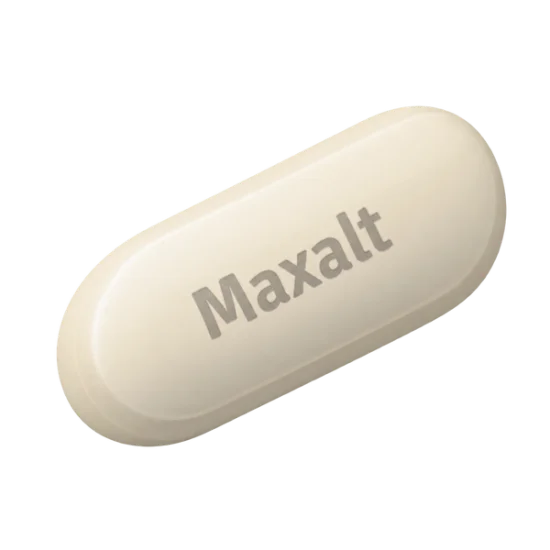
Maxalt is an oral tablet intended for the acute treatment of migraine in adults. The available information does not specify its active ingredient, excipients, or the amount in each tablet.
Mechanism of action
Triptans target serotonin receptors involved in migraine pain. Maxalt acts on 5-HT1 receptors in cranial blood vessels and nearby nerve pathways. This can narrow dilated cranial vessels, reduce the release of inflammatory neuropeptides and interrupt the pain signalling associated with an attack.
- Migraine activates pain-sensitive nerves around the meninges and cranial blood vessels.
- Serotonin-receptor stimulation reduces signalling from those nerves.
- The associated vascular and inflammatory changes become less intense, allowing migraine symptoms to settle.
This action explains why Maxalt is useful for an attack but unsuitable as a general treatment for tension headache, muscular pain or persistent daily headache. The MHRA classifies triptan medicines as targeted acute migraine treatments. The United States Food and Drug Administration describes rizatriptan, the active substance associated with Maxalt, as a selective serotonin 5-HT1 receptor agonist in its prescribing information [2].
Therapeutic indications
Maxalt is intended for the acute treatment of migraine in adults. The tablet is used during an established migraine episode, following the individual dosing instructions supplied by the prescriber.
The product is intended for migraine relief, not for unexplained new headaches, head injury, fever-related headache or pain caused by another untreated condition.
Common mistakes
Several practical errors can reduce the benefit of Maxalt or increase risk:
- Taking it for every headache without confirming the migraine diagnosis.
- Waiting until vomiting, severe pain or marked light sensitivity has developed.
- Repeating a dose too soon because relief is not immediate.
- Combining it with another triptan or an ergotamine medicine.
- Forgetting to mention an SSRI, SNRI, MAO inhibitor or propranolol.
- Using it on many days each month without tracking headache frequency.
- Driving before knowing whether dizziness or drowsiness occurs.
- Treating a sudden exertional headache as an ordinary migraine.
- Taking it to prevent discomfort during sport rather than treating a diagnosed attack.
- Continuing to self-treat when the migraine pattern has changed.
A second common mistake is assuming that a stronger tablet is always the best choice. Higher exposure can increase adverse effects, and the suitable regimen depends on personal health factors and interacting medicines.
Reasons not to use it
Maxalt should not be used by people with:
- Previous myocardial infarction or ischaemic heart disease.
- Prinzmetal’s angina or other coronary vasospasm.
- Previous stroke or transient ischaemic attack.
- Peripheral vascular disease.
- Uncontrolled hypertension.
- Certain serious heart rhythm disorders.
- A known allergy to the active substance or tablet ingredients.
- Another triptan or ergotamine-containing treatment taken within the restricted interval.
| Medicine group | Main concern | Practical action |
|---|---|---|
| SSRIs and SNRIs | Rare serotonin toxicity, with agitation, sweating, tremor, diarrhoea or fast heartbeat | Use only under a prescriber’s plan and seek urgent help for severe symptoms |
| MAO inhibitors | Increased rizatriptan exposure and serotonin-related toxicity | Avoid the combination and observe the required washout period |
| Ergotamine medicines and other triptans | Additive vascular effects and increased adverse-event risk | Do not combine or take close together |
| Propranolol | Increased exposure to rizatriptan | A lower Maxalt dose may be required |
When this is not for you
NOT for you if: you have a contraindication to triptans, an unexplained new headache, or no clinician-confirmed migraine diagnosis.
A new or unusually severe headache needs assessment rather than automatic treatment with Maxalt. A migraine pattern that changes suddenly, starts after exertion or is accompanied by weakness, confusion, fainting, fever or neck stiffness requires urgent medical evaluation.
Chest pressure, shortness of breath, faintness or severe weakness after taking a triptan requires urgent medical attention. Mild chest or throat tightness can occur with triptans, yet it should not be assumed to be harmless when it is intense, prolonged or associated with breathlessness.
Risk factors such as smoking, diabetes, high cholesterol, obesity, strong family history of heart disease or post-menopausal status may require cardiovascular assessment before a triptan is prescribed. The EMA product information describes these precautions for rizatriptan-containing medicines [3].
Unwanted effects
Common adverse effects reported with rizatriptan include dizziness, sleepiness, tiredness, weakness, nausea, dry mouth and sensations of pressure or tightness in the throat, neck or chest. These effects are often short-lived, yet they can be uncomfortable.
Some people notice tingling, warmth, flushing or unusual sensations in the skin. A mild sensation of heaviness may occur after the dose. Strong, persistent or worsening chest symptoms need urgent assessment rather than another dose.
Serious reactions are uncommon but may include:
- Severe allergic reaction with swelling of the lips, tongue or throat.
- Serious heart rhythm disturbance.
- Heart attack or coronary artery spasm.
- Stroke-like symptoms.
- Serotonin syndrome with an interacting medicine.
- Severe abdominal pain caused by reduced blood flow to the bowel.
A useful practical distinction is duration. Brief mild tingling may settle, while persistent chest pain, fainting, severe abdominal pain or neurological symptoms should be treated as urgent warning signs.
The product can also contribute to medication-overuse headache when used too frequently. A diary showing increasing rescue-medicine use is a reason to review preventive treatment rather than simply increasing the acute dose.
Comparison
Maxalt sits within the triptan class of acute migraine medicines. Its role is to stop or reduce an individual migraine attack after the diagnosis has been established. It is chosen according to response, tolerability, speed of action, formulation and medical history.
| Acute treatment category | Typical role | Main limitation |
|---|---|---|
| Oral triptan tablet | Convenient treatment for an established migraine attack | Nausea or vomiting may reduce reliable absorption |
| Non-oral triptan formulation | Useful when vomiting prevents tablet use | May cause local discomfort or require different technique |
| Non-triptan acute medicine | Option when triptans are unsuitable or poorly tolerated | May not provide the same targeted action on migraine pathways |
Rizatriptan is absorbed relatively quickly compared with some oral options, although the actual response differs between patients. A fast onset does not mean every attack will stop immediately. The result can also be affected by taking the medicine after the migraine has become severe, delayed stomach emptying during an attack and repeated use across many days.
The Cochrane review of oral triptans for acute migraine found that triptans can provide meaningful pain relief for some patients, while adverse effects and incomplete response remain possible [4]. A clinician may change the treatment plan if attacks remain frequent, relief is short-lived or side effects interfere with daily life.
Maxalt should not be compared by tablet strength alone. A person may respond well to one triptan and poorly to another because receptor activity, absorption and individual migraine biology differ.
What doctors say
In clinical practice, prescribers usually focus on three questions: whether the headache is genuinely migraine, whether cardiovascular risk permits triptan use and whether acute treatment is being used too frequently.
A doctor will often ask about aura, nausea, light sensitivity, sound sensitivity, menstrual timing, exercise triggers and the number of headache days each month. These details help distinguish episodic migraine from chronic migraine and from other headache disorders.
NICE recommends reviewing treatment when migraine remains disabling despite acute therapy or when attacks occur frequently enough to interfere with work, sleep or family life . A patient may need a preventive strategy when rescue medicine is used repeatedly, even if each individual dose provides relief.
The WHO identifies migraine as a neurological disorder that can cause substantial disability and reduced daily functioning [5]. That clinical perspective matters: the aim is not only to reduce pain, but also to restore normal activity without creating a cycle of frequent medicine use.

Comparison
What customers often ask
Can people under 18 use Maxalt?
Maxalt is not automatically suitable for children or younger teenagers. Paediatric migraine treatment requires an age-specific assessment of diagnosis, body size, cardiovascular history and other medicines. The 2025 NICE guidance for headache management in people under 18, while the 2023 FDA prescribing information describes the established use of rizatriptan in adults and selected adolescent populations rather than universal use in all children . A person under 18 should only use Maxalt when a qualified prescriber has specifically selected it.
How does Maxalt differ from other triptans?
Maxalt belongs to the triptan class and uses a targeted serotonin-receptor mechanism for acute migraine. Other triptans act on related receptors, yet their absorption, duration, interactions and available formulations differ. The 2023 EMA product information for rizatriptan describes its pharmacokinetic profile and the need to account for interacting medicines such as propranolol . A prescriber may select one triptan after considering speed of relief, previous response, vomiting, cardiovascular risk and how long the migraine usually lasts.
Can Maxalt cause dizziness or sleepiness?
Yes. Dizziness, drowsiness, tiredness and weakness are recognised adverse effects of rizatriptan-containing treatment. The 2023 FDA prescribing information, supported by clinical trial and safety review data, advises caution with driving or machinery until an individual knows how the medicine affects them . Severe dizziness, fainting, chest symptoms, weakness on one side or difficulty speaking requires urgent medical attention rather than another dose.
Is there a best time of day to take Maxalt?
There is no universal best clock time because Maxalt is used when an acute migraine attack begins. Taking it early in the established migraine phase may help some people more than waiting until symptoms become severe, provided the diagnosis and prescribed regimen are clear. The 2023 WHO description of migraine as a neurological disorder with variable symptoms and disability supports timing based on the person’s attack pattern rather than a fixed morning or evening schedule . Do not take it routinely at bedtime or on waking when no migraine is present.
Do you offer anonymous delivery?
Your order will be securely packed and shipped within 24 hours. This is exactly what your package will look like (images of an actual item sent). It has the size and look of a regular private letter (24x11x0.7 cm) and its contents cannot be seen.
Physical activity and daily function
Physical exertion often worsens an active migraine because movement can amplify pain, nausea and sensitivity to light or sound. Maxalt is intended to treat the migraine itself, not to improve sporting performance or prevent an exertional headache.
During an attack, rest in a quiet, dark environment can make it easier to assess whether symptoms are improving. Dehydration, overheating, missed meals and sleep loss can also aggravate migraine symptoms, especially around exercise.
Do not take Maxalt simply to push through unexplained headache during strenuous activity. Headache triggered suddenly by exercise, sexual activity or heavy lifting needs medical assessment, especially if it is the first episode or reaches maximum intensity within seconds.
After taking Maxalt, dizziness, drowsiness or weakness may affect concentration. Avoid driving, cycling on busy roads or operating equipment until the effect is clear. Competitive athletes should discuss all medicines with their team clinician because anti-doping rules and medical documentation requirements can change.
How Buyers Rate Maxalt
It helped with the headache but not every time. The nausea was still there during two attacks, and I needed a quiet room even when the pain improved.
The medicine worked within the same morning for me. I had a tight feeling in my throat once, which passed, but I mentioned it before taking another dose.
I took it too late on the first occasion and thought it had failed. Taking it earlier during the next attack seemed more useful, although it did not remove the tired feeling.
It reduced the pain, but my doctor changed the plan after I reported chest discomfort and several days of headaches in one week. The review was more useful than simply repeating tablets.
Sources
- National Institute for Health and Care Excellence (2025). Headaches in over 12s: diagnosis and management, NICE guideline CG150.
- U.S. Food and Drug Administration (2023). MAXALT and MAXALT-MLT prescribing information.
- European Medicines Agency (2023). Rizatriptan product information.
- Cochrane (2015). Oral triptans for acute migraine.
- World Health Organization (2023). Migraine and other headache disorders.