The burning settled more reliably than it had with occasional antacid tablets. I still had symptoms after very large meals, so I changed the meal timing rather than taking extra tablets.
Pepcid
By lowering acid secretion rather than merely neutralising acid already present, famotidine can provide longer acid control than a simple antacid [1]. Pepcid reduces the acid available to irritate the oesophagus, though it does not physically prevent reflux.
Overview
Pepcid contains famotidine, an H2-receptor blocker that reduces stomach-acid production. It is used by adults for heartburn and acid indigestion linked to excess gastric acid, including symptoms associated with reflux.
Directions for use
- Dose: Pepcid contains famotidine, an H2-receptor blocker that reduces stomach-acid production. The regimen for the chosen strength is established with a healthcare professional before starting.
- Frequency: Use the established regimen for the chosen strength; Pepcid is used according to the prescribed or recommended number of tablets and times per day.
- Timing: Take Pepcid by mouth after heartburn begins or before a predictable trigger when preventive treatment is appropriate.
- Duration: Use Pepcid for the duration established by a healthcare professional. Repeated need for acid suppression requires medical assessment.
- Route: Swallow Pepcid tablets orally with water. Do not crush, chew, or split them unless a healthcare professional confirms that the specific tablet may be altered.
Formulation
The active ingredient in Pepcid is famotidine. Famotidine belongs to the H2-blocker class, also called histamine-2 receptor antagonists. It is an acid reducer because it decreases the secretion of hydrochloric acid by the stomach.
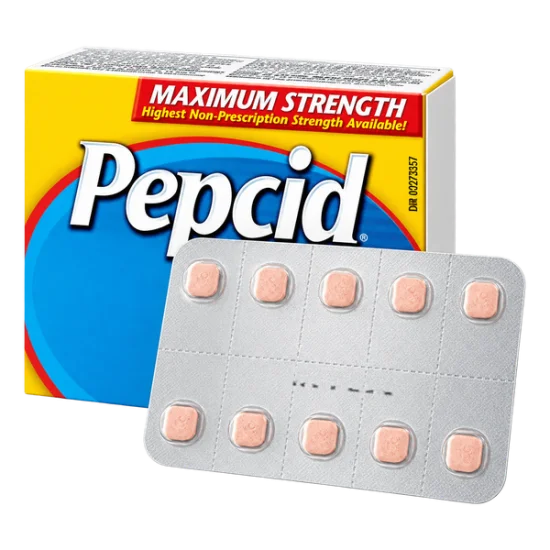
The product is supplied as tablets. The maximum-strength presentation is intended for heartburn relief and prevention, with the exact regimen confirmed with a healthcare professional before starting.
Mechanism of action
Famotidine blocks histamine H2 receptors on acid-producing cells in the stomach. Histamine normally stimulates these cells to release hydrochloric acid. Blocking that signal lowers both resting acid secretion and acid release triggered by meals or other stimulants.
Famotidine acts at the acid-producing cell rather than directly coating the oesophagus or chemically neutralising acid. That distinction explains why it may last longer than a conventional antacid, while its onset can be slower than products that neutralise acid already present.
Therapeutic indications
It is used by adults for heartburn and acid indigestion linked to excess gastric acid, including symptoms associated with reflux.
Pepcid may be used after heartburn begins or before a predictable trigger when preventive treatment is appropriate. Preventive use may be considered when a person has previously experienced symptoms after a known meal or recurring event, provided the regimen has been confirmed with a healthcare professional.
Repeated need for acid suppression may indicate gastro-oesophageal reflux disease, ulcer disease, medication-related irritation, or another problem requiring assessment.
Common mistakes
Several practical errors can reduce the benefit of Pepcid or hide a more serious problem:
- Taking another tablet too soon because the first dose has not produced immediate relief.
- Using Pepcid daily for weeks without reassessing frequent or worsening symptoms.
- Treating chest pressure as heartburn when it is accompanied by breathlessness, sweating, faintness, or radiating pain.
- Crushing or chewing the tablet without confirmation that the specific formulation can be altered.
- Ignoring kidney disease when selecting an H2 blocker.
- Combining Pepcid with several other acid treatments without checking the total regimen.
- Assuming that every burning sensation comes from stomach acid.
- Taking the medicine while continuing a trigger pattern of late, heavy meals and lying down immediately afterwards.
One detail is easy to miss: symptom improvement does not prove that reflux is the only cause. A recurring burning sensation can coexist with gastritis, ulcer disease, medication irritation, or a non-gastrointestinal condition.
Reasons not to use it
- Previous allergy to famotidine or another H2 blocker.
- Moderate or severe kidney impairment.
- A history of unexplained gastrointestinal bleeding.
- Difficulty swallowing, food sticking, or painful swallowing.
- Recurrent vomiting or vomiting blood.
- Unintentional weight loss or persistent anaemia.
- Severe or unexplained chest pain.
- Pregnancy or breastfeeding unless the regimen has been confirmed by a suitable clinician.
- Use of medicines whose absorption depends on stomach acidity.
- Use of multiple acid-reducing treatments without a planned regimen.
People using prescription medicines for cancer, HIV infection, fungal disease, seizures, transplant care, or complex cardiovascular conditions should obtain a specific interaction review before starting regular famotidine.
When this is not for you
Pepcid may not be suitable if you have kidney impairment or warning symptoms. Kidney disease should be discussed before starting treatment.
Long-term or frequent self-treatment can delay diagnosis. Seek medical assessment for unexplained weight loss, anaemia, recurrent vomiting, painful swallowing, food sticking, gastrointestinal bleeding, or symptoms that continue despite treatment.
Severe chest pain, breathlessness, sweating, faintness, or pain spreading to the arm or jaw needs urgent assessment rather than self-treatment for heartburn.
Unwanted effects
Reported adverse effects can include headache, dizziness, constipation, diarrhoea, nausea, or abdominal discomfort. These effects are usually mild, but persistent or troublesome symptoms require a review of the treatment plan [3].
Accumulation can increase the risk of confusion, dizziness, or other central nervous system effects.
Urgent medical attention is needed for facial swelling, difficulty breathing, widespread rash, fainting, vomiting blood, black stools, or severe abdominal pain. These symptoms are not typical uncomplicated heartburn.
Comparison
Famotidine, antacids, and proton pump inhibitors affect stomach acidity through different mechanisms. The best choice depends on how quickly relief is needed, how often symptoms occur, and whether a clinician has identified an underlying condition [2].
| Treatment category | Main action and typical role |
|---|---|
| H2 blockers such as famotidine | Reduce acid secretion through H2-receptor blockade; useful for episodic symptoms and longer acid control |
| Antacids | Neutralise acid already present; often chosen for rapid, short-lived symptom relief |
| Proton pump inhibitors | Suppress the final stage of acid secretion; used for frequent reflux or acid-related disease under appropriate guidance |
Pepcid may suit someone who needs more sustained acid reduction than an antacid provides but does not require the treatment approach used for frequent or complicated reflux. Proton pump inhibitors generally provide stronger acid suppression over continued use, yet they are not simply interchangeable with famotidine.
The phrase “fast relief” needs context. An antacid can act quickly because it works on acid already in the stomach. Famotidine begins reducing new acid production, so its benefit may build over time. A proton pump inhibitor works through a different pathway and is usually selected for a planned treatment course rather than occasional symptom control.
Patients sometimes combine acid-reducing medicines without checking whether the combination is appropriate. That can complicate symptom assessment and expose a person to unnecessary treatment.
What doctors say
In clinical practice, doctors often assess the pattern behind heartburn before recommending repeated acid suppression. Occasional symptoms after a clear dietary trigger may be managed differently from reflux occurring several days each week.
A doctor will usually ask about swallowing, bleeding, weight change, vomiting, night symptoms, and the duration of the problem. These details help identify people who need investigation rather than repeated self-treatment.
Famotidine can be a reasonable option when H2-receptor blockade fits the symptom pattern. Its limitation is that it does not treat every cause of upper abdominal or chest discomfort, and its acid-suppressing effect may be insufficient for complicated reflux.
The MHRA emphasises appropriate use of non-prescription medicines and attention to warning symptoms. European clinical guidance also separates occasional reflux from persistent gastro-oesophageal reflux disease requiring structured treatment [4].
Comparison
What customers often ask
Is Pepcid suitable for older adults?
Older adults may use famotidine when the indication and regimen are appropriate, but kidney function deserves special attention. Reduced renal clearance can increase famotidine exposure and may raise the risk of dizziness or confusion. The MHRA's 2021 guidance advises careful medicine review in older people using treatments cleared by the kidneys. Age alone does not prohibit use, though the regimen should be confirmed before starting. A clinician can adjust the dose when kidney function is reduced.
What happens after stopping Pepcid, and does it need tapering?
Stopping Pepcid after occasional use does not usually require a taper. Symptoms may return if the underlying reflux trigger remains, but that return is different from a withdrawal syndrome. NHS guidance published in 2023 describes reflux management as dependent on symptom frequency and underlying cause. People who have used acid suppression regularly for a prolonged period should obtain an individual plan rather than making repeated changes without review.
How quickly should Pepcid begin to help?
Famotidine may begin reducing heartburn within roughly 15 to 30 minutes, with longer acid control developing afterwards. The EMA's 2023 product information describes famotidine as an H2-receptor antagonist that suppresses gastric acid secretion. A delayed response can occur after a large meal or when symptoms are not mainly acid-related. Severe or persistent symptoms need assessment rather than repeated early dosing.
Can Pepcid be taken with food or on an empty stomach?
Pepcid can be taken in relation to meals according to the confirmed regimen, and food does not remove its H2-blocking action. The FDA's 2022 famotidine prescribing information explains that the medicine reduces basal and stimulated gastric acid secretion. Some people use it before a predictable trigger, while others take it after symptoms begin. Avoid taking extra tablets to compensate for a meal that caused stronger symptoms.
Can people under 18 use Pepcid?
Use in children and adolescents depends on age, formulation, indication, and body weight. A tablet intended for adults should not be given to a child solely because the symptoms sound similar. WHO's 2023 paediatric-medicine principles support weight-appropriate dosing and age-appropriate formulations. A parent or carer should obtain a child-specific regimen before use.
Can Pepcid be combined with other medicines or supplements?
Famotidine can affect the absorption of medicines that need an acidic stomach environment, and kidney disease can increase exposure to the drug. NICE guidance published in 2022 on gastro-oesophageal reflux stresses review of current medicines when symptoms persist or treatment changes. Give the prescriber or pharmacist a complete list of medicines, antacids, vitamins, and herbal products. Do not combine several acid-reducing products routinely without a defined plan.
How does Pepcid differ from a proton pump inhibitor?
Pepcid contains famotidine, which blocks H2 receptors and reduces acid secretion through histamine signalling. A proton pump inhibitor acts further along the acid-production pathway and is generally chosen for a different treatment pattern, such as frequent reflux or confirmed acid-related disease. The 2015 Cochrane Library review described differences between H2 blockers and proton pump inhibitors in acid suppression and reflux treatment. The choice depends on symptom frequency, severity, duration, and clinical findings.
Do you offer anonymous delivery?
Your order will be securely packed and shipped within 24 hours. This is exactly what your package will look like (images of an actual item sent). It has the size and look of a regular private letter (24x11x0.7 cm) and its contents cannot be seen.
Pepcid Tablets and Product Strength
The Pepcid product described here is a maximum-strength tablet presentation. Pepcid tablets are taken by mouth and are intended for acid-related heartburn and indigestion symptoms.
Pepcid product families may exist in different pharmaceutical formats in some markets, including standard tablets or combination chewable products. Those formats can contain different ingredients and should not be treated as interchangeable with the tablets supplied on this page.
The product covered here should be understood through its primary pharmacology: famotidine reduces stomach-acid secretion through H2-receptor blockade. Combination antacid products have an additional neutralising action, while products marketed for soothing or sleep support may contain unrelated ingredients and are not substitutes for famotidine acid control.
Do not select a different strength or dosage form simply because it has a similar product name. A healthcare professional should confirm that the chosen Pepcid regimen matches the symptoms, age, kidney function, and other medicines being used.
How Buyers Rate Pepcid
It helped during the first few nights, but I was still waking several times a week after about two weeks. The useful part was realising I needed an assessment instead of continuing to self-treat.
The tablet was convenient and the relief felt steady. I had a headache on one occasion and stopped taking it until I had checked whether it fitted my symptoms.
Sources
- U.S. Food and Drug Administration (2022). Pepcid AC Drug Facts Label: Famotidine Tablets.
- NICE (2022). Gastro-oesophageal reflux disease and dyspepsia in adults: investigation and management.
- MHRA (2021). Medicines and Healthcare products Regulatory Agency: Yellow Card guidance for reporting suspected adverse drug reactions.
- Cochrane (2015). Medical treatments for gastro-oesophageal reflux disease.